Wharton Stories » How Wharton Helped This Marine Accelerate His Career
Wharton Stories
How Wharton Helped This Marine Accelerate His Career
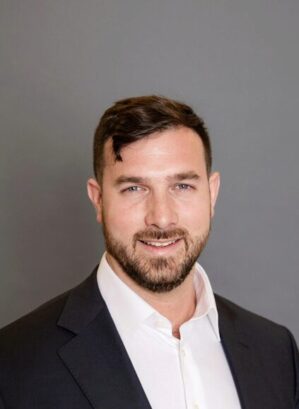
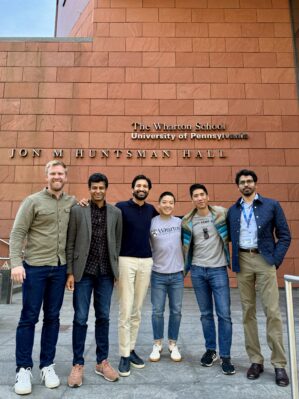
Image: Neal Ellsworth, WG'24, with EMBA students in Prof. Kevin Kaiser’s Valuation course. (Image Credit: Kevin Kaiser)
“The Career Management team was there for every stage: job search strategy, resume, interviews, negotiations – everything. And my executive coach helped me think holistically about what I wanted,” says Neal Ellsworth, WG’24.
When Neal Ellsworth, WG’24, thinks about his career path, he says that it’s never followed a traditional trajectory. After graduating from Michigan State University with a business degree, he wasn’t drawn to corporate life. Instead, he wanted something that would test him physically, intellectually, and globally. That turned out to be the U.S. Marine Corps.
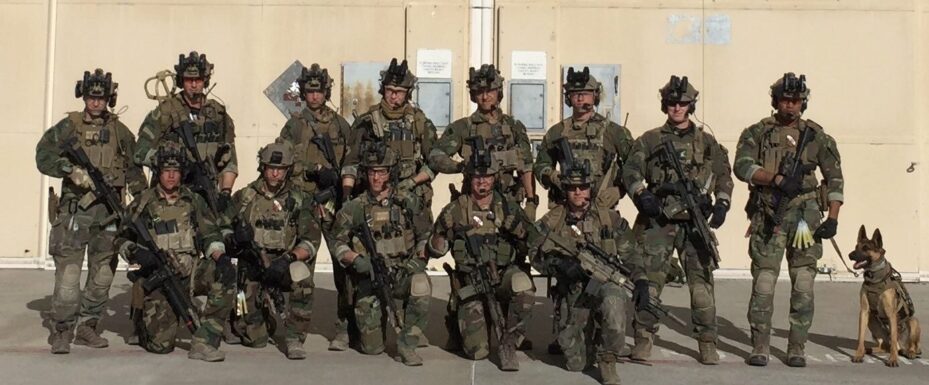
Neal Ellsworth with his MARSOC team. (Image Credit: MARSOC)
As an infantry officer, Neal deployed to Australia where he first learned about special operations missions. Soon after, he became a Special Operations Officer with the U.S. Marine Corps Forces Special Operations Command (MARSOC), completing multiple overseas deployments. Graduate school, he thought, wasn’t in the cards.
But after returning from deployment, a fellow veteran changed his perspective. “He advised that an MBA from a top-tier program could help me transition to the private sector,” Neal notes.
That encouragement sparked a new chapter. Conversations with veterans several years ahead of him helped Neal see graduate business education as not just possible, but potentially transformational. And when he began exploring programs, Wharton rose to the top.
“The veterans community at Wharton welcomed me even before I applied,” he explains. “They shared their experiences, helped me understand the process, and made me feel like I already belonged. That sense of community was a huge factor.”
Neal was accepted into Wharton’s full-time MBA program in 2020, but his career took an unexpected turn when he was selected to serve as a liaison to the House Armed Services Committee, an opportunity he couldn’t pass up. While working on Capitol Hill, he learned about Wharton’s MBA Program for Executives and realized it was the perfect fit.
“A friend encouraged me to consider the Executive MBA because I had a decade of experience, and I’d be learning alongside other mid-career professionals,” he explains. “It felt like the right move.”
Neal began Wharton’s EMBA program while still on active duty, finishing his final months on the Hill. After leaving the military, he joined Vannevar Labs, a venture-backed defense technology startup.
He recalls, “It was an amazing experience getting real-time exposure to a high-growth company while learning the business frameworks behind everything we were doing.”
“They were there for every stage: job search strategy, resume, interviews, negotiations — everything,” he says. “And my executive coach helped me think holistically about what I wanted.”
The career team helped him build a detailed spreadsheet to assess roles, industries, and compensation, an exercise that proved especially valuable for someone transitioning from the military, where salary structures are public and standardized.
Neal Ellsworth with his daughter at graduation. (Image Credit: Allyson Ellsworth)
“In the military, there’s no negotiating your pay,” explains Neal. “Having to assess my market value was completely new. They helped me understand not only what I was worth today, but how to think about the long-term trajectory of each opportunity.”
That preparation paid off. As he transitioned from the military, Neal was fielding three strong offers — each with different strengths. With the help of Wharton’s career team, he negotiated confidently and ultimately chose defense tech.
Lifelong Support for Alumni
Neal spent several transformative years at Vannevar Labs as a business unit leader, helping the company scale from 40 to 280 employees. He built one of the company’s business units from the ground up, an experience he describes as “an MBA in action every single day.”
Recently, Neal was ready to explore a new challenge. This time, he approached the job search with more precision, leveraging the frameworks and tools developed during his time at Wharton.
Neal also turned to Wharton’s Career Management team, which offers alumni lifelong support. “I met with my Wharton executive career coach regularly,” he says. “In the end, I received four offers; having that amount of choice is amazing. I’m so grateful that this level of career coaching continues for alumni.”
Leveraging the Full Power of Wharton Resources
So, what exactly did Neal utilize as a Wharton student and alumnus to accelerate his career?
He breaks it down:
One-on-one Executive Coaching “Consistent sessions helped me refine my goals, prepare for interviews, and negotiate offers with confidence.”
Career Data and Frameworks “The tools provided, particularly the compensation and role-mapping spreadsheet, still guide my decisions today.”
The EMBA Job Board “The EMBA job board focuses on mid-career roles, not just entry-level MBA positions. And because I was in the EMBA program, employers treated me as a highly experienced full-time professional making a transition — rather than a student.”
The Wharton Network “From defense-tech leaders to classmates in gaming, media, tech, and energy, I used Wharton’s network to explore industries I had never considered before. The willingness of people to talk with me was incredible.”
Neal Ellsworth with his Learning Team on the Philadelphia campus. (Image Credit: Anastasia Forte)
Classmates
“The diversity of experience in Wharton’s EMBA program was eye-opening. In the military, career paths are linear. At Wharton, I realized you can take your career in so many directions.”
A Transformational Experience
“Wharton changed the trajectory of my career,” says Neal. “The classes, especially Prof. Kevin Kaiser’s Valuation, shaped how I think about value creation, strategy, and opportunity cost. I use those lessons every day, for both business decisions and personal career decisions.”
When asked what advice he would give current or prospective EMBA students, Neal keeps it simple: “Jump in and use the resources. Even if you’re not planning a transition now, you will eventually. Wharton gives you the tools, but you have to use them.”
Current Position: Principal Product Manager, Systems and Technology Research
Military: Special Operations Team Commander and Liaison to the House Armed Services Committee; U.S. Marine Corps Forces Special Operations Command (MARSOC)
Previous Education: Michigan State University, BS Business
Wharton Stories
How Wharton Is Helping This Heart Surgeon Expand Her Impact Beyond the Operating Room
Image: Dr. Sarah Minasyan, MD, WG’23 and classmates reuniting for an educational session on AI in healthcare (Image Credit: Karl Power)
“I now understand how hospitals run from a business perspective. I can speak the language. That changes everything,” says Dr. Sarah Minasyan, MD, WG’23.
Why would a successful cardiothoracic surgeon get her MBA at Wharton? For Dr. Sarah Minasyan, MD, WG’23, the answer traces back to a Russian saying she grew up with: “Live 100 years, learn 100 years.”
Her path to Wharton — and to the operating room — was shaped long before medical school. Raised in the former Soviet Union, she experienced political and personal upheaval in her teenage years. After the fall of the Iron Curtain, the country she had been taught to trust began to crumble. During that same period, she lost her father to brain cancer.
Her mother, recognizing both the shifting political landscape and the need for a different future, made the life-altering decision to leave. It took six years and a complex web of bribes, but they finally received permission to emigrate. “When we left, we had almost nothing,” Sarah recalls. “My parents were scientists, and the most expensive things in our home were books.”
In the U.S., she accelerated quickly, learning English, graduating valedictorian, and earning her undergraduate degree from UCLA. Her interest in medicine stemmed from both practicality and inspiration.
“Living in Russia, I saw how the world can quickly change,” she says. “But the human body does not change. If I ever needed to start over in another country, I could continue practicing medicine because it is universal.”
As for inspiration, a family friend who was a renowned congenital cardiac surgeon “walked on water” in the eyes of her community. Watching a highly respected master surgeon at work sealed her career choice of cardiothoracic surgery.
Recognizing a Knowledge Gap
For years, Sarah thrived in high-stakes surgical environments. But over time, she observed a growing challenge. Physicians and
Dr. Sarah Minasyan, MD, WG’23, with UC Davis cardiac surgery residents. (Image Credit: Angelica Martin, MD)
administrators, she realized, often spoke two different languages. “Hospital administration spoke business, and I didn’t understand that language,” she says. “Yet as a surgeon, you work within complex systems. You have to engage with the business side whether you intend to or not.”
When the COVID-19 pandemic hit, the mother of four saw both a crisis and an opportunity. “I realized this was the time to learn the language of business,” she says. “And if I was going to do it, I wanted to learn from the best.”
Her husband, also a surgeon, helped her research programs. When they saw that Wharton offers a San Francisco cohort, the decision was made. She applied only to Wharton. “It was an investment in myself. Go big or go home.”
Stretching to Meet a New Challenge
Sarah entered Wharton with an MD and years of surgical leadership, but she describes her early coursework with humility: “Many of my classmates were engineers or deeply immersed in the business world. I had so much catching up to do.”
Her classmates quickly became a source of support, especially during weeks when she was juggling major surgeries and exams. “I’ve operated in teams my whole career, but this was a new kind of team. It was phenomenal,” notes Sarah.
Sarah also came to appreciate how her clinical background offered unique value. She explains, “Surgeons make critical decisions with limited information every day. That translates directly into business leadership. I didn’t realize how relevant that instinct was until Wharton.”
Global Perspective and Applied Impact
Although COVID canceled her plannedGlobal Business Week in Sweden, Sarah refused to let the opportunity disappear.
Dr. Sarah Minasyan, MD, WG’23, at graduation with her husband Jason Marengo, MD. (Image Credit: Wharton MBA for Executives)
Instead, she designed her own independent study and traveled there anyway, withProf. Guy David (Alan B. Miller Professor; Chair, Health Care Management Department) advising her project. She used the Wharton network to connect with Swedish health leaders and investigate why Sweden’s heart failure readmission rates in rural areas are dramatically lower than those in the U.S.
Her findings were illuminating: remote monitoring, telehealth, and mail-in labs formed the backbone of Sweden’s success. “The prototype is there,” she notes. “Adopting similar models in the U.S. would require policy changes, but it’s possible — and it would save lives and reduce costs.”
Following graduation, Sarah was recruited by Utkars Jain, WG’25, to the clinical advisory board ofHEARTio, an AI startup aiming to address one of the biggest bottlenecks in emergency medicine: rapid triage of chest-pain patients. “If you can accurately triage patients early, you free up beds, reduce costs, and improve outcomes. It aligns perfectly with my expertise and Wharton’s emphasis on operational impact,” she says.
The Value of a Wharton MBA
For Sarah, the value of the Wharton MBA is about opening new worlds:
Career relevance: “I now understand how hospitals run from a business perspective. I can speak the language. That changes everything.”
Expanded networks: “You open a new world for yourself from CEOs and innovators to policymakers. The Wharton brand opens doors.”
Family benefit: She often jokes that the degree is also an investment in the next generation because the network benefits her kids as well as her classmates’ children.
Personal growth: “You keep on learning. You stay curious. That matters.”
“Consider it an investment in yourself and in your future influence,” she says. “If you want to lead, if you want a seat at the table, you need the knowledge and confidence to speak the language of business. Wharton gives you that and more.”
Previous Education: UCLA, BS Environmental Biology; University of Southern California, MD
Wharton Stories
Prof. Kent Smetters Challenges EMBA Students to Think Like Economists
Image: Prof. Kent Smetters in conversation with former Federal Reserve Chairman Alan Greenspan at Perry World House in 2019. (Image Credit: Wharton Magazine)
“We teach you how to think critically, how to use data effectively, and how to adapt. That way, when your industry shifts — and it will — you’ll have the knowledge and skills required to innovate and lead the way forward,” says Prof. Kent Smetters.
At Wharton, Prof. Kent Smetters, the Boettner Chair Professor, is known among EMBA students for teaching one of the program’s most challenging core courses: Managerial Economics. But as one former student says, “It’s hard in the right ways.”
“My goal isn’t to make the course hard just to be hard,” explains Smetters. “It’s about pushing students to think differently.”
Prof. Kent Smetters (Image Credit: The Wharton School)
Instead of memorizing formulas, students learn to take a real-world narrative with numbers and data and translate it into an economic model that provides insight. The course teaches them to think through tradeoffs, understand optimization, and apply theory in practical situations.
“That kind of critical thinking is what leaders need in order to make smarter decisions,” he says.
Smetters’ demanding approach reflects his broader philosophy: research and teaching should prepare people not only to understand the world as it is today but also to anticipate how it will change. That perspective comes from a career that bridges academia, public policy, and applied economics.
Engineering a New Kind of Policy Analysis
Smetters grew up in rural Ohio before earning his PhD in economics from Harvard. Rather than immediately pursuing an academic career, he took an unusual path for a new PhD: he went to Washington, DC to work at the Congressional Budget Office. Later, he served as Deputy Assistant Secretary of Economic Policy at the U.S. Treasury during the George W. Bush administration, a period that included the aftermath of 9/11, the Enron collapse, and the drafting of Sarbanes-Oxley.
Those experiences gave him a deep appreciation for how policy is made and what changes are needed. “Agencies are sometimes criticized for being biased, but that’s not the case. The problem is that they are very far behind when it comes to modeling.”
That insight ultimately led to the Penn Wharton Budget Model (PWBM), which Smetters now directs. PWBM is a software-engineering-driven shop that builds sophisticated, scalable models of how policies interact across the economy. Policymakers on both sides of the aisle turn to PWBM for analysis that is rigorous, transparent, and trusted.
“What distinguishes us,” Smetters explains, “is that we’re not chasing headlines. We do deeper analysis, and our models are built so others can understand and build on them. It’s modern economics combined with engineering. That’s why we’re trusted across the political spectrum.”
PWBM also offers a free certificate program, giving participants (including some Wharton EMBA graduates) a deeper understanding of policy modeling and fiscal analysis.
Research With Purpose
Smetters’ academic work continues to push boundaries in applied theory, fiscal policy, and finance. His projects range from modeling the long-term effects of Social Security reforms, to analyzing the effectiveness of minimum wage as a redistribution tool, to studying how tax policies affect venture-capital-backed entrepreneurs.
“This work is very math intensive,” he says, “but the purpose is always to make research useful at scale. It’s about solving problems that once seemed too big to model.”
Smetters’ applied approach has earned recognition, including theTIAA Paul A. Samuelson Award for his research on annuitization.
Beyond the Classroom
While Managerial Economics is the main way EMBA students interact with Smetters, he also supervises independent studies.
One standout independent study project involved a student’s exploration of whether wine could become a financial asset class. Using economic and financial modeling, the student discovered how wine auction dynamics correlated with markets and even identified underpriced vintages.
Other projects have ranged from startup concepts to industry-specific analyses, all grounded in applying classroom concepts to real-world questions.
“My role is to help students take the tools they’ve learned and apply them in creative ways,” he explains. “The best projects start with a question that matters to the student and then build an economic and data-driven approach to finding answers.”
A Message to Prospective Students
For prospective students, Smetters offers a candid perspective on Wharton’s EMBA program: “This is the hardest MBA program in the hardest format. You and your household are making a serious investment, and you need to come in with that mindset.”
But the payoff, he emphasizes, is worth it. “Graduates are incredibly satisfied because they know they’ve been pushed hard to grow,” he says. “We don’t just teach you the tools of your trade today, because those will change. We teach you how to think critically, how to use data effectively, and how to adapt. That way, when your industry shifts — and it will — you’ll have the knowledge and skills required to innovate and lead the way forward.”
Current Position: Boettner Chair Professor and Professor of Insurance and Risk Management (Wharton); Director of the Penn Wharton Budget Model; Faculty in Applied Mathematics and Computational Science (Penn); Faculty Research Fellow, National Bureau of Economic Research
Wharton Stories
Wharton’s Global Business Week: Expanding Horizons, Building Connections
Image: Wharton EMBA students in Milan for Global Business Week. (Image Credit: Meg Chiodo)
“[This class] is a prime example of why I chose Wharton: learning, applying, and connecting on a global scale,” says James Brown III, WG’26.
Since its earliest days, Wharton’s MBA Program for Executives (EMBA) has made international learning a cornerstone of the curriculum with its requiredGlobal Business Week (GBW).
Today, GBWs span multiple destinations each year, allowing students from all three cohorts (Philadelphia, San Francisco, and Global) to choose topics and regions that align with their professional goals and personal interests. What hasn’t changed, says GBW Program Director Cathy Molony, is the guiding principle: each location explores issues at the leading edge of global business.
“GBW is about more than academics. It’s about learning across perspectives, connecting with students from other cohorts, and gaining access to opportunities you couldn’t create on your own,” explains Cathy. “It’s a priceless experience that builds both knowledge and lifelong connections.”
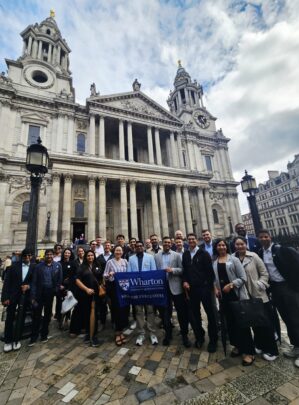
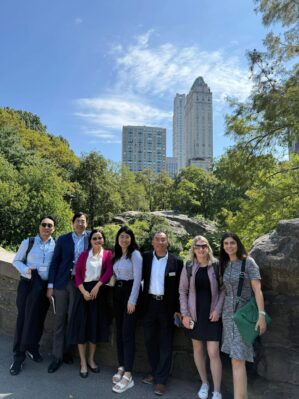
Below, six EMBA students reflect on their recent GBWs in Spain, London, New York, Sweden, Italy, and Argentina — and how these experiences expanded their learning and their networks.
Competitive Advantage in the Leisure Industries, Spain James Brown III, WG’26, San Francisco Cohort
For James Brown III, Spain was the ideal destination to explore the intersection of business and leisure. “I wanted to go beyond tourism to really understand the industries that drive local economies like sports, tourism, food, and wine,” he says. “The insights were directly relevant to my work in entertainment and the economic impact of my projects across the U.S.”
Caption: James Brown with classmates in Madrid. (Image Credit: Anastasia Gracheva)
The week began in Barcelona, where students met with city officials and tourism leaders. Sessions explored the effect that large conventions, cruise ships, sporting events, and wineries have on the local economy. They also visited publicly owned FC Barcelona, where they learned about the rivalry with privately owned Real Madrid, as well as the teams’ differing business models.
In Madrid, discussions extended to sports and entertainment entrepreneurship. Students met a former soccer player who now owns Marbella Football Club along with several subsidiary companies, including a talent agency and predictive analytics tech company. Another session explored the strategy of acquiring smaller talent agencies to consolidate resources.
Outside of academics, the week was rich with cultural experiences and bonding. Wine tastings, stadium tours, dinners, and informal discussions helped students connect across cohorts. “The week gave us the chance to mingle, expand networks, and even dream about potential future collaborations, maybe buying a football club together,” he laughs.
For James, the value of the week was immediate and practical. “Having access to these organizations and leaders showed the power of the Wharton brand,” he notes. “The learning was immersive, applicable, and something I can take back to grow my company. It’s a prime example of why I chose Wharton: learning, applying, and connecting on a global scale.”
Exploring AI in Emerging Technologies in London Katrina Siegfried, WG’26, Philadelphia Cohort
Katrina Siegfried chose London for her GBW because of the subject matter. “I work in a highly regulated industry, and there’s hype around AI, but not everyone knows how to generate real value from it,” she says. “I wanted to see how companies in another highly regulated sector are using AI, and how regulators in the UK are approaching it.”
Caption: Katrina Siegried with classmates in London. (Image Credit: Diane Sharp)
The week included visits to NatWest andMcKinsey, as well as conversations with regulators shaping AI legislation. The NatWest visit was particularly powerful. She explains, “This was a bank responsible for bringing down the UK financial system in 2008. Seeing how they’ve rebuilt and now use AI successfully was incredible.”
Another highlight was the visit to McKinsey, where the presentation was so practical that it inspired Katrina to write her own AI program when she returned to the hotel that evening. “My favorite part of Wharton’s EMBA program is learning something and immediately applying it, and this week was that on steroids.”
Beyond academics, she says the opportunities to get to know her classmates were “invaluable.” Dinners, high tea, and karaoke gave the group time to connect. A Tube strike gave them even more time together, walking and riding buses together around the city.
For Katrina, she says the week encapsulated the best of Wharton’s EMBA experience: “Cutting-edge business insights, practical knowledge, and lasting connections with classmates from around the world who share the same drive to learn.”
Private Equity on Wall Street Jeong Min (JM) Yun, WG’26, Global Cohort
Caption: JM Yun with classmates in NYC. (Image Credit: Takeshi Nagase)
As a finance lawyer originally from Seoul and working in Singapore, JM Yun was drawn to New York for its focus on private equity (PE). “There were many interesting locations, but I wanted to explore PE withProf. Jules van Binsbergen” (the Nippon Life Professor in Finance and Anthony L. Davis Director of the Joseph H. Lauder Institute for Management and International Studies).
Students visited six PE firms ranging from mega funds to medium-sized players, while Prof. van Binsbergen layered in lectures on the history and future of private equity. Walking tours of Wall Street added historical perspective, including a visit to Ground Zero the day before 9/11’s anniversary.
As a member of the Global cohort, JM valued the chance to connect in person with peers from all three cohorts. “We got to know each other at dinners, Broadway shows, and alumni networking at thePenn Club. These conversations deepened connections and gave me perspectives from students in tech, AI, and venture capital.”
Academically, the week reframed JM’s understanding of PE. “Before, I thought of PE as deep financial engineering,” he says. “But what stood out was the operational aspect, creating value through industry expertise and operational excellence. As a lawyer, I’ll apply this lens in Asia-Pacific where PE is growing rapidly.”
Customer Centricity in Sweden Margot Gates-George, WG’26, San Francisco Cohort For Margot Gates-George, choosing Sweden was about the opportunity to learn directly fromProf. Peter Fader, the Frances and Pei-Yuan Chia Professor. “I had heard from an alumnus that you can’t go to Wharton and not take one of his marketing classes,” she explains. “When I saw he offered a GBW in Sweden on customer centricity, I knew I had to go.”
Caption: Margot Gates-George with classmates and Wharton alumni in Stockholm. (Image Credit: Mats Karlsson, WG ‘24)
The week began with an introduction to Swedish culture and workplace values followed by full days of visits with firms like Funnel IQ, IKEA, Paradox Games, and Scandinavian Airlines.
As a former Navy pilot, Margot found the visit to Scandinavian Airlines especially meaningful. “I’d flown with them before, but hearing directly from the CEO about how they invest in both operations and customer experience gave me a completely new perspective,” she says.
For Margot, the biggest takeaway of the visits was the importance of understanding who drives a company’s revenue. “If 90% of your revenue comes from 10% of your customers, how do you build strategy around them? That question reshaped how I think about marketing and customer engagement.”
Outside the classroom, the opportunity to forge meaningful connections with peers from different cohorts proved just as valuable. Margot deliberately sought out people she would not have had a chance to connect with otherwise, spending evenings at dinners, museums, and karaoke. She walked away from her GBW experience grateful for having learned from Prof. Fader and for having forged deep, lasting relationships with classmates who truly inspired her. “It felt like we were full-time students for a week. Without the usual distractions of work and commitments of family, we had the time to really focus on each other, build friendships, and share advice. That was as rewarding as the academic experience.”
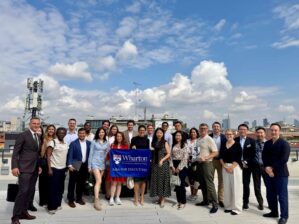
Sustainability and Luxury in Italy Parashar Saikia, WG’26, Global Cohort
Caption: Parashar Saikia with classmates on the rooftop at Buccellati in Milan. (Image Credit: Meg Chiodo)
For Parashar Saikia, Italy offered a chance to learn about a completely new sector. “Working in oil and gas, I wouldn’t otherwise have the opportunity to see the luxury industry up close,” he explains. “I also wanted to explore sustainability through a completely different lens.”
The week opened with a Boston Consulting Group session framing sustainability in luxury, followed by visits to companies like Ferrari, Ferragamo, Prada, Armani Hotels, and Alessi. Each company showed a different approach to sustainability, whether rooted in culture, governance, environmental stewardship, or preserving craftsmanship.
“I was pleasantly surprised at how seriously these companies walk the talk in the areas they focus on,” says Parashar. “The balance between profitability and sustainability isn’t a simple trade-off. These companies are weighing both strategically.”
He adds that another highlight was the class bonding, which happened during the company visits as well as dinners and opera nights. “This was a great opportunity to connect with people across cohorts in person.”
For Parashar, the biggest value was the unique access Wharton provided to the luxury industry. “At Ferragamo’s headquarters, we sat in a 13th-century palace!” he says. “These are doors that would never open without Wharton.”
Doing Business in Turbulent Environments, Argentina Ovsanna Khachikian, WG’26, Philadelphia Cohort
For Ovsanna Khachikian, choosing Argentina came down to the professor. “I had taken a prior course withProf. Exequiel (Zeke) Hernandez [Max and Bernice Garchik Family Presidential Professor] and knew his GBW course would be just as thoughtfully designed. He presents frameworks that are clear and transferable, helping make sense of complexity across industries and geographies. The focus on navigating volatility through entrepreneurship made it especially relevant in the current era of economic and geopolitical uncertainty,” she says.
Caption: Closing out the week with remarks and reflections at the Palacio Duhau Park Hyatt in Buenos Aires. (Image Credit: Astral Group)
The week started with an academic overview at IAE Business School before moving into visits with leaders across public and private sectors. The group met with a venture capitalist and startup founders as well as a senior leader from Mercado Libre, the leading e-commerce platform across Latin America, founded by Wharton alumnus Marcos Galperin. They also participated in a Q&A session with Minister of Finance Pablo Quirno, another Wharton alumnus, who shared insights into the current administration’s reforms aimed at stabilizing the economy.
One key lesson came from a fintech startup founder, who raised millions at the ideation stage and was able to simultaneously expand into multiple markets. “In the absence of stable markets, we learned that relational governance takes precedence,” Ovsanna explains. “His reputation and credibility allowed him to attract investment even when the broader market-based institutions were unreliable.”
Beyond academics, Ovsanna embraced opportunities to connect with classmates during shared meals and bus rides as well as while touring landmarks, including Teatro Colón and La Recoleta Cemetery. “Especially when abroad, I find shared learning and exploration really accelerates connection and fosters a rare depth of camaraderie among classmates,” she says. Her personal highlight was exploring Argentina’s multicultural identity with a stroll down Armenia Street in Palermo with classmates, appreciating the references to her heritage.
For Ovsanna, the impact of GBW went far beyond the classroom. “This was a masterclass in leading through uncertainty that would be difficult to capture in a textbook or case study. I left Argentina with lasting insights on how the boldest leaders remain focused on priorities even amidst instability and why relationships and resilience matter as much as strategy,” she says.
Current Role: President & Chief Creative Officer, Story House, Inc. (Co-Founder)
Previous Education: Brown University, BA Psychology
Image Credit: Roka Studios
Katrina Siegfried, WG’26 Cohort: Philadelphia
Location: Golden, CO
Current Role: Software Engineering Development Manager, Terumo Blood and Cell Technologies
Previous Education: University of Colorado, BS Mechanical Engineering; University of Colorado, Master’s in Integrative Physiology, Engineering Management, Computer Science
Image Credit: White Room Studio, Singapore
Jeong Min (JM) Yun, WG’26
Cohort: Global
Originally From: South Korea
Location: Singapore
Current Role: Legal Consultant
Previous Education: Korea University, BA Korean Law; Vanderbilt University, JD; University of Michigan, MBA
Image Credit: Danielle Poff
Margot Gates-George, WG’26
Cohort: San Francisco
Location: San Francisco Bay Area
Current Role: Public Affairs Manager, Meta
Previous Education: U.S. Naval Academy, BS Political Science and Government
Image Credit: Lori Harrington
Parashar Saikia, WG’26, Global Cohort Cohort: Global
Originally From: India
Location: Houston, TX
Current Role: Scenario and Prioritization Manager, Shale and Tight, Chevron
Previous Education: Louisiana State University, BS Petroleum Engineering
Image Credit: Michelle Hill
Ovsanna Khachikian, WG’26
Cohort: Philadelphia
Location: New York City
Current Role: Director of Human Resources and Operations, NYC Department of Education
Previous Education: University of California, Berkeley, BA Political Economy; Columbia University, Master’s in Leadership and Policy
Wharton Stories
How This Veteran Is Building Business Acumen With Wharton’s EMBA Program for the Next Stage of Growth
Image: Brad Mears, WG’26, (Center, Rear) ringing the bell with his Figure coworkers. (Image Credit: Nasdaq, Inc.)
“When I joined my company, we were small and growing fast. Now, the opportunities ahead are bigger and more complex than when I started, which makes the timing of Wharton even more relevant,” says Brad Mears, WG’26.
When Brad Mears, WG’26, got out of the U.S. Marine Corps, he thought about getting an MBA, but the timing wasn’t right. He had just begun working in the private sector and decided to get more professional experience before going to business school.
Brad Mears, WG’26, during his service in the U.S. Marine Corps. (Image Credit: Justin Hemeyer)
After eight years, first at PayPal and then the startup Figure, Brad was ready for school. He explains, “I realized that to grow as a leader, I needed a deeper understanding of business fundamentals. I’d developed strong product management skills but — to be truly effective in financial services — I needed the broader business toolkit that Wharton provides.”
A Career Built in Fintech
Brad’s career in tech started at PayPal, where he worked as a program manager. “It was an awesome place to start and get my foot in the door,” he says. But soon, he felt the pull toward a steeper learning curve and the chance to work directly in product management.
That led him to Figure, a fintech company that’s transforming capital markets through blockchain. Over the past six years, Brad has played a role in the company’s remarkable growth from a 100-person startup to a public company listed on Nasdaq (FIGR). “Being part of that journey has been incredible,” he says. “And now the opportunities ahead are bigger and more complex than when I started, which makes the timing of Wharton even more relevant.”
Why Wharton
Brad’s brother, a 2024 graduate of the Philadelphia EMBA cohort, had nothing but positive things to say about the program. Coupled with the GI Bill and Yellow Ribbon Program, which made the degree financially accessible, Brad knew he had found the right fit at Wharton’s San Francisco campus.
“Wharton was a no-brainer,” he says. “The opportunity to earn an Ivy League MBA while continuing to work in San Francisco and stay connected to the tech community was perfect.”
Classroom Insights That Translate to Work
Brad Mears, WG’26 (far left), with classmates on Wharton’s Philadelphia campus (Image Credit: Aansh Jarmarwala)
From the start, the curriculum delivered immediate value. Courses in micro- and macroeconomics gave Brad new ways of understanding the products he manages, which are often in the housing finance space.
“On the micro level, it was eye-opening to learn about pricing and customer decision making,” he notes. “On the macro side, understanding how the Federal Reserve operates and how those decisions ripple through the financial industry was incredibly impactful. It gave me insights I use every day.”
Other courses have been equally relevant. “I loved the class on Disruptive Innovation because it’s so applicable to working in tech in the Bay Area. And Prof. Gad Alon‘s Scaling Operations class has been spot on for where we are as a company.” (Prof. Alon is Wharton’s Jeffrey A. Keswin Professor, as well as Director of the Jerome Fisher Program in Management & Technology.) “When I joined, we were small and growing fast. Now that we’re public, the issues we’re tackling are exactly what we discuss in class.”
The Wharton Community
For Brad, being back in a classroom setting is part of the appeal. “It’s refreshing to step into an environment where the stakes are lower than at work, while engaging in discussions with smart people who bring diverse perspectives,” he says.
His classmates, he adds, are a highlight. “There are so many impressive people in my cohort doing interesting things. We’re all at inflection points in our careers, and I know in five to 10 years I’ll be amazed by where everybody is.”
The San Francisco location has made the experience even more rewarding. “I ride my bike to class, and I’ve built a strong core group of friends here. Those relationships will last long after graduation.”
Balancing Family, Career, and School
Brad began Wharton with a newborn at home, so balancing school with a demanding job and family life has been challenging. The key to finding balance, he says, is clear communication, setting expectations, and prioritization.
“You have to be intentional about your time,” he says. “There will always be more you could do, but you can’t do everything. Be clear on what you want to get out of the program, protect time for family, and decide what’s enough for you. The program attracts high achievers, but you don’t have to say yes to everything.”
Looking Ahead
As Brad reflects on his experience so far, the combination of academic growth, career impact, and community stands out.
“It’s been demanding, but it’s worth it,” he says. “Wharton is giving me the tools, the perspective, and the network to continue growing as a leader — and that will pay dividends for the rest of my career.”
Current Role: Director of Product Management, Figure
Image Credit: Ryan Gish
Previous Education: Georgia Institute of Technology, BS in Finance and Business Administration
Wharton Stories
Wharton EMBA Admissions Director Shares Tips on Writing Strong Essays
“Take time to be thoughtful and be yourself. We want to really get to know you through these essays.” – Barbara Craft, Director of Admissions for The Wharton MBA Program for Executives
Hear from Barbara Craft, Director of Admissions for Wharton’s MBA Program for Executives, on how to give both you and your essays the best chance at success
As the University of Pennsylvania’s founder, Benjamin Franklin, once said, “I have already made this paper too long, for which I must crave pardon, not having now time to make it shorter.” Franklin’s sentiment is often echoed by many applicants to Wharton’s EMBA program as they work to submit their admissions requirements; after all, we are asking you to be thoughtful and condense a lot of important information about yourself into two short essays, in addition to the checklist of other materials required to complete your application.
When it comes to the essays, the key is taking the time to reflect on the questions. Don’t miss the opportunity to think about how you want to frame your personal and professional experience and how this program can help your future career. Wharton MBA Program for Executives Director of Admissions Barbara Craft advises applicants to start the essay writing process early.
“The questions are posted in advance to give you plenty of time to draft and rework answers before submitting your application,” said Barbara. “We want to see thoughtful essays, and it takes time to figure out what you want to say and how to convey that in the framework of the essays.”
Just as important as giving yourself time is ensuring that the essays reflect the real you. Being honest in your responses and staying true to who you are as a candidate is essential.This is when asking a colleague or friend for help is useful. “Have someone who knows you well read your essays and then ask them if the essays sound like you,” Barbara advised. “And ask that same person – or perhaps another friend or colleague – to help proofread your final drafts. There is no excuse for essays with grammar errors and typos,” said Barbara.
Another pitfall to avoid is plagiarism, which is the number one reason to deny an application based on an essay. The Wharton MBA Program for Executives Admission team runs plagiarism checks on all essays and expects professionalism from applicants.
If you are currently working on your application or plan to start soon, here are tips for tackling each specific essay:
The first essay
The first question asks about your career objectives and how this program will help you achieve your goals. “We want to see that you have thought about your career and how this program will add value. We want to make sure you have done your due diligence both on our program and why it is the right fit for you and your goals,” said Barbara.
She added that applicants should focus on where they currently are in their career and what they would do with an MBA. “Your plans may change, but we want to make sure you have been thoughtful about this program and why you want to come here now.”
The second essay
The second essay asks you to reflect on your personal, professional, and academic background and consider how you intend to make meaningful and specific contributions to the Wharton community. This could involve sharing your unique experiences, skills, and perspectives that you bring to the table and explaining how you envision using them to enrich the Wharton community. The essay is an opportunity to demonstrate your understanding of what Wharton values and how you align with those values, showcasing how your presence would enhance the overall learning and collaborative environment at Wharton.
“Not everyone has the same experiences in this area. Our students come from a variety of backgrounds and everyone’s perspective adds value and enhances the learning environment,” Barbara noted. “What is most important is to be authentic and thoughtful in your reflection. There is no perfect answer.”
The optional essay
The optional essay is an opportunity to share information that may be missing in other parts of the application.
“This essay is truly optional,” said Barbara. Don’t feel compelled to use this space unless you have something to share that can’t be conveyed in another part of the application, such as circumstances that impacted your undergraduate academic performance.”
The bottom line
The biggest piece of advice for all of the essays is to take time to be thoughtful and be yourself. “We want to really get to know you through these essays. So, make sure they are in your voice, give strong examples, and tell us who you are instead of telling us what you think we want to hear.”
Tech to Business Strategy and Operations with a Wharton EMBA
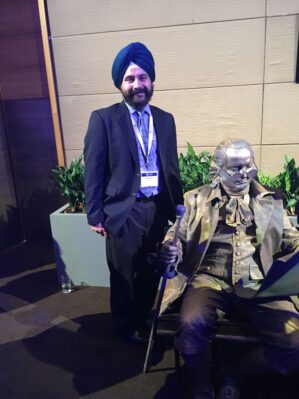
Image: Guljot Grover, WG’16, at Wharton’s graduation with Dean Geoffrey Garrett. (Image Credit: Gaurav Gupta)
“Wharton helps everyone, whether you’re looking to move up, broaden your scope, or completely change direction. It’s a springboard,” says Guljot Grover, WG’16.
When Guljot Grover, WG’16, came to Wharton’s MBA Program for Executives, he was already 16 years into a successful tech career. Based in Scottsdale at the time, Guljot rose through the ranks at IBM, starting as a software engineer and moving into leadership positions in his post-IBM career. But he was ready for more.
“I had a high-level familiarity with functions like marketing and sales,” Guljot recalls. “But I wanted a deeper and more effective understanding of how those parts of the business operated.”
That curiosity — and a desire to push himself beyond his comfort zone — led him to Wharton.
Guljot’s search for an executive MBA was deliberate. He researched rankings and program formats, but Wharton stood out for one simple reason: “This is a real MBA, not MBA-lite,” he says. “The faculty, the curriculum, and the alumni network are world-class.”
A Strategic Career Change
Before Wharton, Guljot’s professional expertise was firmly rooted in technology. But Wharton opened new doors and he has pivoted to business roles since graduation.
Guljot Grover, WG’16, on Wharton’s Philadelphia campus. (Image Credit: Ammi Tan)
Specifically, he transitioned first into strategy and later into business operations roles. Today, he serves in a key leadership position at Varian Medical Systems (now part of Siemens Healthineers), heading its Business Operations and Program Management organization for North and Latin America, working closely with customer-facing teams of the Americas region.
“Wharton gave me the toolkit and confidence to make the pivot,” Guljot explains. “If I had tried to do it on my own, it would have been harder and taken longer.”
Guljot credits Wharton for giving him more than technical knowledge.
“My favorite part of the curriculum ended up being classes that focused on soft skills,” says Guljot. “One class focused entirely on public speaking. That first session — standing in front of a room full of mid-career and senior professionals — was unsettling. But, by the end, it felt natural. That experience was transformative.”
The biggest benefit, notes Guljot, is the network of relationships he developed in the program.
“I learned about both of my post-Wharton roles from Wharton connections,” he says. “These are people who not only offer mentorship and introductions, but reach out to say, ‘Hey, you’d be great for this position.’ That’s powerful.”
Advice for Prospective Students
For professionals interested in elevating their personal brand, Guljot says Wharton is more than a credential — it’s a catalyst.
Guljot Grover with classmates during Wharton’s Global Business Week in Shanghai, China. (Image Credit: Erin Lavelle)
“Wharton helps everyone, whether you’re looking to move up, broaden your scope, or completely change direction,” he says. “It’s a springboard.”
He encourages prospective students not to underestimate the power of the Wharton network both during the program and after graduation. “Even when things are going well, having a network of people in every industry around the world who will answer your call or reply to your email is invaluable.”
Guljot remains actively involved with the Wharton community, supporting Career Week, speaking on EMBA panels, and participating in alumni interviews for the Penn Alumni Ambassador Program.
“It’s about paying it forward,” he says. “Wharton helped me make a major career shift. I’m always happy to help others navigate that journey, too.”
Dr. Ehab Hanna’s Logical Approach to the Wharton EMBA Essay
The essay questions help you reflect on where you are and where you want to go. They help you identify the reasons for coming to this program.
When Dr. Ehab Hanna, WG’18, was working on his application to Wharton’s MBA Program for Executives, he spent a lot of time thinking about the essays. Having come to the U.S. from Egypt at the age of 25 for his medical residency, English was not his first language. And with a medical background, he didn’t consider himself a writer. However, he knew the essays were an important part of the application process so he developed a strategy to make them less daunting.
Ehab’s Three Steps for the Three Required Essay Questions
Think about what information to convey overall.
Make lists about what to communicate in each essay.
Draft paragraphs around those lists and make sure the stories flow.
How His Steps Worked
Ehab notes that it was easier to pick the topic for some of the essays than others. For example, he says it wasn’t difficult to describe his career objectives and how he will use this degree to attain those objectives. “Having a medical degree and being on an upward trajectory in my career, a lot of people were asking me why I wanted to go back to school. I had spent a lot of time thinking about – and explaining — my motivation and goals.”
In his essay, Ehab discussed his role as chief medical information officer for Universal Health Services in Philadelphia, where he is responsible for 25 hospitals’ clinical systems, including development, installation, and support. In other words, he is responsible for which software is used, how it is deployed, how it is built, and identifying missing pieces. To manage the deficiencies in commercial software, his group built its own software development shop, which had grown into a startup within the company.
“Having transitioned from medical practitioner to an administrative and technical role, especially at an investor-owned company, I wanted an MBA to better understand the business side of health care. Working on the startup for our innovation products also drove me to want an MBA,” he explains.
Further, he had observed first-hand how the current model of health care is costly and unsustainable. “There is a need for people who understand both the clinical and business world so that we can balance providing good care with good operational environments and efficiencies. There are a lot of opportunities to cut costs and provide higher quality healthcare.”
With those reasons in mind, he made his list and began to build an essay around it.
The second question asks applicants to describe a time they were faced with a challenge and how they responded. Initially, Ehab considered discussing how he came to the U.S. as a doctor without knowing English. However, he decided it was too far in the past and he wanted to talk about something more recent. After much consideration, he decided to share the story of his divorce.
“I made a list of the personality characteristics I wanted to highlight in that story, like how I pride myself on being level-headed and prioritized taking care of our three sons and getting along with my wife in the divorce process. I described how I focused on those goals and was able to achieve them.”
He notes that it’s important to be authentic in the essays. “Don’t pick something just because you think it’s what the Admissions Committee wants to hear,” he cautions. “If Wharton isn’t a good fit, nothing you write in the essay will change that. Share your unique story and the strengths you will bring to the program.”
The third essay, says Ehab, was more straightforward, but required a lot of thought. Applicants are asked how they will handle the additional demands on their time once they enroll.
“As a physician, you are constantly studying to keep up to date with medicine and to maintain board certifications. I’m almost always studying for something so that time was already built into my schedule,” he says. As for job responsibilities, Ehab notes that he had finished the implementation stage of the clinical system and built the startup — and he had two physicians on board to fill in for him when he was at Wharton.
The logical approach worked for Ehab, whose essays helped earn him a spot in the East Coast class of 2018.
Ehab with his three sons, who inspired him as he studied for the GMATs
Studying for the GMAT
Of course, the essays are only part of the application. The GMAT was another challenge for Ehab, who doesn’t come from a quantitative background.
“My first reaction to the GMAT requirement was, ‘Do they seriously want me to take this test?’” he says. “When I asked if they could waive it, the admissions counselor said, ‘We don’t waive it. But trust me, you want to take the GMAT.’”
Ehab says he now understands why the test is required and is glad he took it. “It got me thinking about math and statistics concepts I hadn’t thought about in years. Even preparing for the writing part of the GMAT was helpful because I brushed up on my writing skills. That preparation was invaluable.”
For preparation, Ehab studied with free courses on Khan Academy while his kids (who are now 13, 11 and 8) did their homework. “Studying with them turned out to be beneficial because they saw that adults don’t stop learning or growing in life – and I am now able to help them with their math homework,” he says, noting that he also took a paid online test preparation program.
When studying for the GMAT, Ehab recommends starting as early as possible. “It’s better to pace yourself and make sure to leave time to take it again if needed.”
A “Worthwhile” Process
Looking back, Ehab says it was “worthwhile” to go through the application process. “The essay questions help you reflect on where you are and where you want to go. They help you identify the reasons for coming to this program. And the GMAT preparation helps you get back into the routine of studying if you haven’t done that in a while.”
The process also makes you think realistically about timing. Ehab says he thought about applying the prior year, but realized that he had too much on his plate with a life event like a divorce. He decided it would be better to wait to apply the next year.
He adds, “The application process is a good self-evaluation of whether this is the right time and the right program for you.”
Current Position
VP, Chief Medical Information Officer, Universal Health Services
Current Location
Philadelphia
Prior Education
Ain Shams University, Medicine and Biology, Cairo, Egypt
Wharton Stories
Nuclear Engineer Shares Steps for Writing Admissions Essays
That was a commonality I saw with myself and other classmates — we are all trying to solve complex problems and I could offer a different perspective to those problems.
When Jay Disser, a nuclear engineer, sat down to start the application for Wharton’s MBA for Executives Program, he realized that the essay portion was not going to be as easy as he thought. Accustomed to drafting work reports based on scientific or mathematical analysis, the open-ended, reflective nature of the questions was going to require a completely different type of writing.
“I saw that the essays were going to be challenging because I don’t spend a lot of time thinking about my weaknesses or reflecting on how I approached a specific situation — that’s not my personality. And how should I choose what to write about? How would I pick which events are the most applicable to the questions?” he says.
Jay’s Steps for Writing Admissions Essays
1. Decide What Information You Want to Convey
The first thing he did was write down the information he wanted to convey in his essays. Fortunately, he had already done this to some extent when he prepared for the interview. Not wanting to be caught off guard during that conversation, he had come up with a list of likely questions and written down answers.
“That provided a good outline of the information and major events I could incorporate into the essays,” he says.
2. Match up Information to the Essay Questions
Then he converted that outline into a plan of attack, deciding which pieces of information best fit with each essay question. “By matching the information to each essay question, I was able to see if a certain event would take too long to explain and should be substituted with a simpler concept to convey the same information.”
3. Essay #1 – Goals and Objectives
The first essay question asks about career objectives and how Wharton will help applicants achieve those goals. Following his outline, Jay began by describing his field. “The area of nuclear engineering is different than some more traditional fields so I wanted to provide a baseline of understanding about what I do for a living.”
He also wanted to clarify why he wasn’t seeking a PhD, which may seem like the next natural step for people in his field. “My goal is to move into management and I’m interested in the quantitative and global analysis that Wharton’s curriculum provides. I referenced some courses to show direct applicability to my goals.”
4. Essay #2 – Responding to a Challenge
The second essay asks applicants to describe how they responded to a challenge.
When Jay wrote his first draft, he picked three different examples. But after reviewing it, he realized it was too scattered and he needed to narrow it down to one phase in my career.
“I chose to focus on the time when I worked as a civilian nuclear operator for the U.S. Navy,” he says. “I was young and needed to establish credibility with people who had been in the Navy longer than I had been alive. Navigating that environment required learning a lot about leadership skills.”
Jay adds that he also talked about the principles required of operating a nuclear reactor like integrity, backing people up, and encouraging a questioning attitude. “The overarching principles are to be safe and effective so everyone goes home at the end of the day.”
5. Essay #3 – Juggling Work and School
The last required essay about how students will balance work and school was a bit easier for Jay. He explains that he had already completed a Master’s degree in nuclear engineering while working full-time, and his company was very supportive of him going to Wharton for an MBA.
“I assumed that the biggest question in everyone’s mind about my logistics was how I would commute from rural Idaho, where I was living at the time. I explained that I had a plan to show up on time by arriving on Thursdays and staying over until Sunday — two extra days — but I was committed to making this work,” he says.
The fourth essay is optional and is an opportunity for applicants to provide any additional information they feel is important for the Admissions Committee to know. Jay chose to use this essay as a chance to explain his poor undergraduate GPA and the unique value he would add to the program.
He notes, “My master’s GPA was very high compared to my undergraduate GPA so I wanted to discuss how I have matured over the last 10 years and prioritize things differently than when I was in college.”
Jay also highlighted how he would add professional diversity to the program. “I discussed how my job involves national security. I was working for a government contractor to stop the spread of nuclear weapons. While I don’t focus on revenues or profit models, I do work on complex global problems that require people, countries, and multiple stakeholders to come to a global solution. That was a commonality I saw with myself and other classmates — we are all trying to solve complex problems and I could offer a different perspective to those problems.”
7. Ask Someone to Review Your Answers
Once he had drafts for each essay, he asked a colleague to review his answers. “It’s difficult to put these self-reflective answers in writing much less open yourself up to criticism from a friend. So rather than ask a close friend who may have hesitated being candid with feedback, I asked a colleague who I knew would have good judgment, but wasn’t afraid to hurt my feelings,” says Jay.
Because of that revision process, Jay ended up with multiple drafts of each essay. It was worth it, as he earned a spot in the Wharton San Francisco EMBA class of 2018.
Looking back, Jay says that he appreciates the rigorous application process. “It’s clear that the Admissions Committee is carefully creating cohorts to make this the most robust and valuable experience possible. You would never be able to join a group this diverse in terms of backgrounds and geography that operates at such a high intellectual level anywhere else.”
Transforming Leadership and Teamwork: Strategic Success in Wharton’s Executive MBA
Image: Dean Rothbard and Prof. Nurmohamed with Wharton EMBA students enjoying cake after completing an electric car simulation (Credit: Serenity Lee)
“This course anchors Orientation Week — a critical period that sets expectations, builds momentum, and begins the process of transformation,” says Deputy Dean Nancy Rothbard.
When students in Wharton’s MBA Program for Executives arrive on campus for Orientation, they hit the ground running with classes. First up is Foundations of Teamwork and Leadership, which brings students together from all three cohorts (Philadelphia, San Francisco, and Global) and serves as the academic entry point into the Wharton MBA.
Why begin here? According to Deputy DeanNancy Rothbard and ProfessorSamir Nurmohamed, who co-teach the course, the answer is clear: Leadership and teamwork are not just soft skills. They’re essential, learnable competencies that shape success across every dimension of the EMBA journey.
“This course is more than just a course,” says Rothbard. “It anchors Orientation Week — a critical period that sets expectations, builds momentum, and begins the process of transformation.”
The decision to place the class at the very start of the program is intentional. As Nurmohamed explains, “Students will be working in teams for the duration of their time at Wharton. This course gives them a structured opportunity to build those relationships and understand team dynamics right away — not weeks or months into the program.”
Bridging Theory and Practice
One of the most distinctive elements of the class is the Wharton Teamwork and Leadership Simulation, a multi-day, high-intensity group exercise where students run a fictional electric vehicle company over a simulated nine-year span. This simulation creates a realistic setting for students to test out leadership frameworks in real time.
“Leadership sounds easy until you have to do it,” Rothbard notes. “In this course, students make decisions, experience group dynamics, and then get feedback — all in a safe environment where learning, not perfection, is the goal.”
Nurmohamed adds, “There’s a knowing-doing gap when it comes to leadership. You can know what the right thing is in theory, but it’s hard to do in practice. This course is built to close that gap.”
A “One EMBA” Approach
A key innovation in the EMBA Orientation is the mixing of all three cohorts — and the benefits are both practical and cultural.
“Bringing the three cohorts together was a deliberate design choice,” Rothbard explains. “It reinforces the idea that this is one EMBA program, not three separate tracks. Students immediately start to build a broader, more diverse network that spans industries, geographies, and perspectives.”
Nurmohamed adds, “It’s incredibly enriching. You’re hearing from tech leaders in San Francisco, finance professionals in New York, entrepreneurs from Europe or Asia — all in the same classroom. That diversity of experiences and perspectives deepens the learning and makes the course much more impactful.”
Setting the Tone for the Program
“The fact that we teach this class first is a value statement,” says Rothbard. “We are signaling to students that leadership and teamwork aren’t side topics — they are central to what we believe makes a great business leader.”
As EMBA students are already navigating complex roles in their organizations, the timing of the course creates a unique opportunity for immediate application. “We constantly hear from students, even a week later, that they tried something they learned in class in their own company,” says Nurmohamed. “It’s learning by doing — and doing it immediately.”
The course builds three core competencies that are revisited throughout the EMBA program:
Leadership behaviors: mobilizing people toward shared goals
Team dynamics: understanding how to be an effective team member and leader
Organizational awareness: adapting to change and building high-performing cultures
“We leave them with a few key messages,” says Rothbard. “First, that leadership and teamwork are skillsets — they’re not magic. You can get better at them. Second, that there’s a lot of noise and myth around leadership, and we want them to use evidence and feedback to guide their development. And third, that knowing isn’t doing. You have to practice these skills to grow.”
The structure of the course with nightly reflection, real-time feedback, and faculty-led debriefs reinforces these messages in a powerful, lasting way. “Years later,” says Rothbard, “students come back and remember specific decisions and lessons from this course. It sticks with them.”
A Transformational Start
“Everyone comes into the EMBA program energized and ready,” says Nurmohamed. “This course captures that energy and channels it into something foundational. It’s the perfect way to begin their Wharton journey.”
And yes — sometimes there is cake in the course (see photo above). But more importantly, there’s clarity, camaraderie, and a strong first step toward becoming the leader each student aspires to be.